
Risk Profiling Comparison
See How We Stack Up Against Risk Profiling Tools
Is a Risk Score Enough?
Your clients’ true risk behavior shows up when markets get tough. But risk profiling tools capture only a snapshot of how a client feels about investment risk today. DNA Behavior helps you understand the person behind the score, including the natural tendencies that surface under stress, so you’re ready to advise them as market conditions change.
- One-Time Natural Behavior Discovery
- Complete Financial Behavior Profile
- Advisor-Client Matching Insights
- Behavioral Bias Identifier
- Communication Keys for Framing Advice
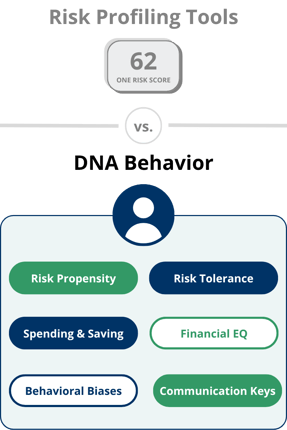
DNA Behavior vs. Risk Profiling Tools
| Capability | DNA Behavior | FinaMetrica | Nitrogen (Riskalyze) | Oxford Risk |
|---|---|---|---|---|
|
Investment Risk Tolerance
|
✔
|
✔
|
✔
|
✔
|
|
Risk Propensity - measured separately from Risk Tolerance
|
✔
|
✘
|
✘
|
Partial
|
|
Natural Risk Behavior - measured once and separately from learned risk behavior
|
✔ |
✘
|
✘
|
✘
|
|
Complete Financial Behavior - spending, saving, and goal-setting
|
✔
|
✘
|
✘
|
✘
|
|
Financial EQ - emotional response to money and markets
|
✔
|
✘
|
✘
|
Partial
|
|
Behavioral Bias Identifier
|
✔ (16)
|
✘
|
✘
|
Partial
|
|
Insight into Client Reactions Under Market Stress
|
✔
|
✘
|
✘
|
✔
|
|
Advisor-Client Matching Insights - including partners and family
|
✔
|
✘
|
✘
|
✘
|
|
Communication Keys for Framing Advice
|
✔
|
✘
|
✘
|
Partial
|
|
Questions Not Tied to Market Scenarios or Hypothetical Investments
|
✔
|
✘
|
✘
|
Not Disclosed
|
|
Psychometric Validation
|
Independently Validated by Georgia Tech (97.1% accuracy)
|
Academically Validated
|
No Published Validation
|
Vendor-Reported
|
What Risk Profiling Tools Leave Out
Risk profiling tools can play a role in the advice process, but it’s important to recognize their limits. FinaMetrica offers a well-validated assessment, but risk tolerance is all it measures. Nitrogen (formerly Riskalyze) turns risk preference into a single Risk Number that is easy to use, but it publishes no psychometric validation. Oxford Risk goes further into financial personality, including composure and impulsivity, but stays focused on investment suitability. None of them measures natural risk behavior separately from learned risk behavior, or looks beyond investment risk to how clients spend, save, set goals, and want advice delivered.
What Drives Each Client’s Decisions
Under pressure, people tend to fall back on their instinctive tendencies, a pattern we call the Reversion Effect. That’s why the Natural Behavior Discovery is the foundation of everything we measure: it shows how a client is likely to respond to market stress. In a strong market, a client may answer a risk questionnaire as if they’re comfortable with risk, while our Natural Behavior Discovery could show they’re cautious by nature. If that's the case, the client is more likely to want out in a downturn, and knowing it early helps you prepare them. Our Market Mood™ tool adds a real-time view, combining live market data with each client’s profile to show who may be feeling fear or exuberance as markets move.
A Learned Behavior Discovery is also available to show how a client has adapted over time.
| Natural Behavior Discovery | Learned Behavior Discovery | |
|---|---|---|
|
What It Shows
|
How a client tends to approach risk, money, and decisions |
How a client has adapted over time, including adjustments that may be harder to sustain when they run against natural tendencies |
|
When It's Taken
|
Once, at the start of the relationship |
Optional, usually at the annual review |
|
Time to Complete |
10–12 minutes |
Varies |
|
How It's Used |
A baseline for risk, planning, and communication |
A check on what’s changed since the last review |
One Profile for the Whole Relationship
A single DNA Behavior profile gives you what you need from the first meeting on. It shows both how boldly a client tends to make decisions and how comfortable they are living with the outcome. A client who is quick to act but uneasy with losses needs a different approach than one who is cautious on both, and the profile shows you which one you’re working with. Because the Natural Behavior Discovery is taken once, it serves as a stable reference point for the life of the relationship. And the same assessment works for your advisors and staff, giving your firm one set of behavioral data for client matching, hiring, and team development.
Keep Exploring
-
Learn more about the full Financial DNA feature set.
-
See How We Compare with DiSC, MBTI, Hogan, and others.
-
Read about our Validation Process.
See the Difference for Yourself
Book a pressure-free 1:1 demo to see how DNA Behavior compares with the risk profiling tool you use today.
